
• Home

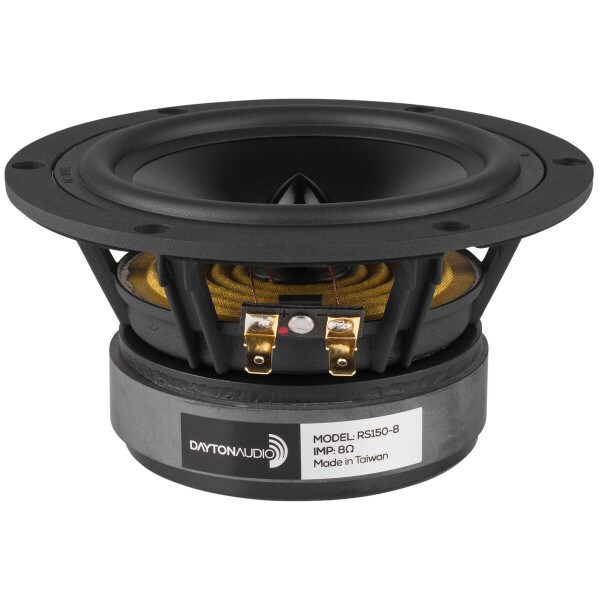
Dayton Audio RS150-8 6" Reference Woofer
Dayton Audio
Part #295-354

Dayton Audio RS150-8 6" Reference Woofer
Dayton Audio
Part #295-354  
Model: RS150-8
Dayton Audio Reference Series RS150-8 6" woofers deliver exceptional clarity, detail, and dynamics—and of course, incredibly low distortion.
Key Features
  • One of the lowest distortion, highest resolution driver series available
  • Low-distortion high-excursion motor system with two short-circuit paths
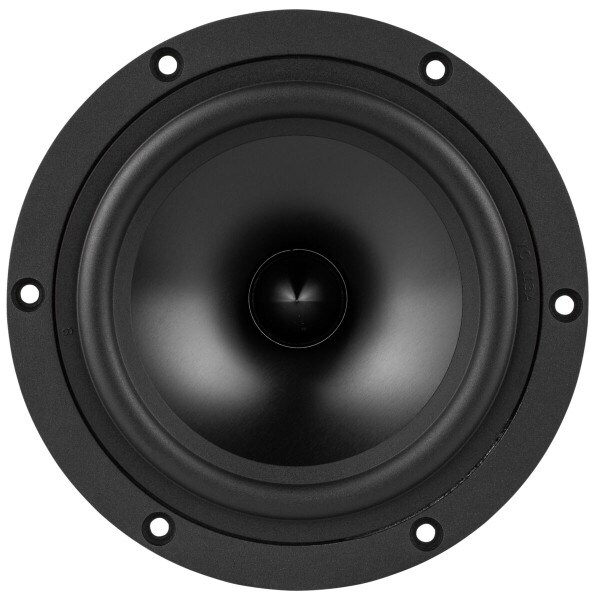
  • Compliant suspension and rigid black anodized aluminum cone for strong bass performance
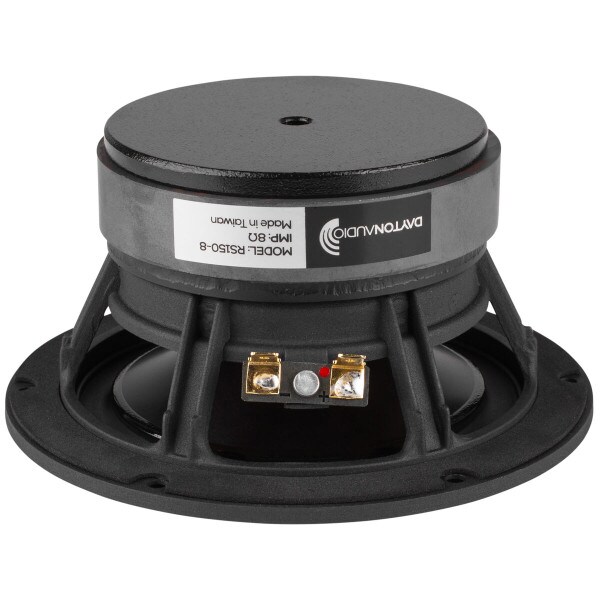
  • Heavy-duty 6-hole cast frame, low-loss rubber surround, and solid aluminum phase plug
  • Designed and engineered in the USA
Your Price: $49.98
MSRP: $64.99
Save $15.01 (23%)
Bulk Pricing
Quantity: Qty: 1-3 $49.98/ea
Quantity: Qty: 4-9 $47.48/ea
Quantity: Qty: 10+$44.98/ea
Ships next business day. Details

In Stock

Free Shipping available on orders over $99.00 in the US. Details

Overview

Dayton Audio RS150-8 6" Reference Woofer
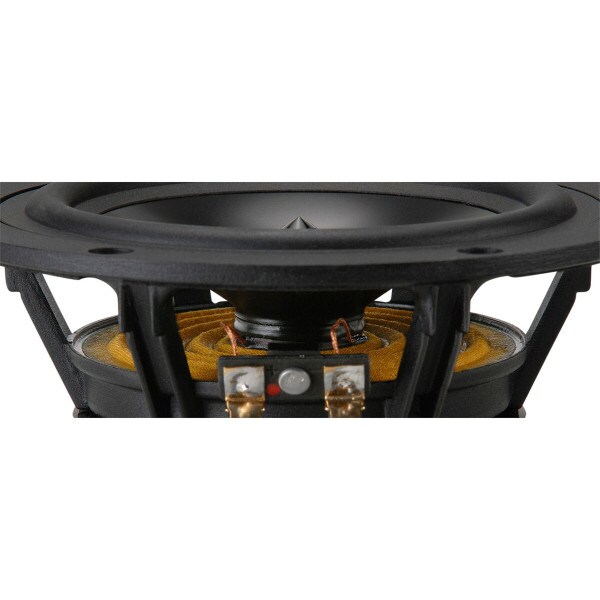
The Dayton Audio Reference Series was conceived with one goal in mind—low distortion. Each speaker was carefully designed and optimized to offer the highest performance with the lowest distortion levels. At the same time, by focusing on features that contribute to sound quality and eliminating unnecessary frills, the drivers offer value unparalleled in the industry. Dayton Audio Reference Series RS150-8 6" woofers deliver exceptional clarity, detail, and dynamics—and of course, incredibly low distortion.

Product Details

BrandDayton Audio
ModelRS150-8
Part Number295-354
UPC844632088742
Unit of MeasureEach
Weight3.55

Product Specifications

Nominal Diameter6"
Bolt Circle Diameter5.43
Moving Mass Of Diaphragm (Mmd)7.4
Power Handling (RMS)40 Watts
Power Handling (MAX)80 Watts
Impedance
Frequency Response47 to 4,200Hz
Sensitivity88.7dB 2.83V/1m
Voice Coil Diameter1"

Thiele-Small Parameters

Resonant Frequency (Fs)47.8Hz
DC Resistance (Re)6.3Ω
Voice Coil Inductance (Le)0.55mH
Mechanical Q (Qms)1.66
Electromagnetic Q (Qes)0.43
Total Q (Qts)0.34
Compliance Equivalent Volume (Vas)0.59ft³
Mechanical Compliance of Suspension (Cms)1.63mm/N
BL Product (BL)5.59T·m
Maximum Linear Excursion (Xmax)4mm
Surface Area of Cone (Sd)85cm²

Materials of Construction

Cone MaterialAluminum
Surround MaterialRubber
Voice Coil Wire MaterialCopper
Voice Coil FormerAluminum
Basket / Frame MaterialCast Aluminum
Magnet MaterialFerrite

Mounting Information

Overall Outside Diameter5.91"
Baffle Cutout Diameter4.78"
Depth2.89"
# Mounting Holes6

Optimum Cabinet Size (determined using BassBox 6 Pro High Fidelity suggestion)

Sealed Volume0.1ft³
Sealed F3116Hz
Vented Volume0.26ft³
Vented F368Hz

Specifications

Q&A

Have a question? Ask owners. Have a question about this? Ask people who own it.
Start typing and see existing answers.
17 Questions
Why did you choose this?

Quality item on sale. Also 6" size is what I need.

I needed to replace some Design Acoustics PS6.A speakers that had disintegrated over time.

i am replacing one that i have damaged with a screwdriver when not being focused on what i was doing!!!

Spoke with Tech Support, this was the suggested replacement for my broken RS150S-8.

Still not enough

Sorry to beat a dead horse, but 3rd order at 3k will be 20db down at 7k ELECTRICALLY--but the breakup itself is a solid 10db peak. The net response is therefore only 10db down about 1 octave from the crossover point; this is definitely still audible. Still wondering the best way to tame the peak (without the expense and part count of a very high slope crossover.)

Best Answer: If you want to do this passively, you only have two choices. You can use a lower crossover frequency and trade off some of the high end response, or you can design a very high order crossover. There is no magic tricks to make it work, but there is always a compromise. Personally, with this driver, I would do a lower crossover freq. Say 1.5k at 4th order LR. Two coils and two caps isn't terrible and gives you more slope. You can always go 6th order, but in my experience, complicated crossovers like this tend to make more problems than they fix. Even 4th orders are more than I like to use if I can avoid it

Also, have you listened to the driver crossed over this way? The peak you are speaking of is inherent in this type of cone, but it isn't usually nearly as noticeable as the measurements make it seem. In fact some people tend to think of it as a fuller, richer sound as long as it isn't a blaring noise that only certain, very low quality, drivers tend to produce.

what tweeter could i mate with this woofer?

Best Answer: I used the Morel 298 tweet, crossed it @ about 2700HZwith a second Order (12db/octave) Two-Way Crossover and it sounds great. You can use a few different tweeters but in my experience Morel sounds great and is very reliable for the money. Good luck!

Do you think I could get a crossover of 2,500 with this driver or do I need to go lower?

Best Answer: 2.5K Hz should be fine with this speaker. This speaker has an impressively wide usable range
(up to 4300 Hz) I actually used a 4.5K Hz crossover (PE# 260-148) 'cause that's what had on my bench (and not being made of money) and got away with it (my ears like it). The low-pass starts rolling off around 4K anyway so I really didn't notice any gaps in the sound. Not the audiophile solution I'm sure, but like I said, It worked for me.

Hello, I am planning a build of a stereo bookshelf speaker system, and I recently purchased my drivers/crossovers from Parts Express. I crossed the Dayton Audio RS150-8 6" Reference Woofer and Dayton Audio DC28F-8 1-1/8" Silk Dome Tweeter at 3000hz. Without building the enclosure, I wired these components together to make sure they were working properly. They seem to be in perfect condition, but I noticed that the woofer was handling the vast majority of the sound I was putting through them. Only on exceptionally high passages of music would the tweeter start to take on some of the workload, otherwise falling silent. Is this anything I should be worried about? Is my crossover point too high? Or is it normal for a two-way system such as mine to be heavily reliant on the woofer?
Any feedback would be great, thanks.

Best Answer: try to crossover at 2000 hz

Can you please tell me what is the best cutting freq. for RS150-8 (alu) and DC28F-8? Thanks

Best Answer: In a 3 way configuration I tested 500 Hz to be the performance for this woofer. In a 2 way system 2800 Hz performed the best with the silk dome tweerer.

What are the best crossover cuts for a 3 way design with RS150, RS75 and DC28F?
RS150 in a vendet cabinet 60Hz tuned.

Best Answer: The RS75 has a relatively narrow peak band between 1k Hz and 5k Hz. I would recommend crossing at 1k Hz and 3.5k Hz using a 2nd order crossover. This will avoid the break-up nodes on the RS150 and the RS75. You will need to add an inline 4ohm resistor on the RS75 to match the impedance of the other drivers. I highly suggest using a non-inductive wire-wound since it will be transmitting high frequencies. Another thing to note, if possible, I would recommend lowering the tuning of your cabinet to 47 Hz to get better base extension out of the RS150.

Which dayton audio crossover would fit best with these?

Best Answer: Since the usable bands are so close, I would suggest a 4,000 crossover point. Would build it from components from Parts Express. Will need to balance levels I am sure, using resistor networks to keep impedance same.

Hi All,

I am about to build my first set of 3 way towers and was planning on using a TMWW arrangement.

Tweeter = DC28FS-8, Mid = RS150-8, Woofer = 2 x RS225-8 in parallel. The crossover i am planning to use is the DA X03W 375/3000.

The 2 woofers will be in a 1.09 cubic foot sealed enclosure.

My questions are:

1, Do you believe this is a suitable crossover for this set up?
2, Do you believe 1.09 cubic feet is an adequate size sealed enclosure for the 2 woofers? Or can this size enclosure be ported?
3, Any other thoughts or opinions are welcome.

Thanks

James.

Best Answer: carefully consider all the factory parameters before you purchase any speakers. Consider response frequency, enclosure parameters and port them after they are built if you feel it is necessary.

I only have personal experience with your tweeter of choice. I used it in a 2 way center channel I built. The voice clarity is accurate and natural. I used a 2500 Xo, but that is a matter of application and taste as much as it is parameter driven. I used the unshielded version in my rear surrounds on a 5.1 system.
For Woofers (x2) you need to know if you will be running them in series or parallel and set up your crossover accordingly.
And remember before you buy, call PE and talk to a Tech and bounce what you are thinking about doing off of them. They may have a new way to skin a cat that you have never considered.
I have never been disappointed with any Dayton product. Drivers, Tweeters, Amps, and XO's. Just do your homework.
And remember, your speaker design is a process, enjoy it...:-)

Your choice of XO is a matter of choice and seems within the design parameters of the driver selection you have made.

Recommended vented volume is .26 cu. ft. what would be correct port size?

Best Answer: For my project using this speaker, in a .27 cu. ft. box (net volume, factoring for woof/tweet/x-over/port displacement) I found that a 1" port (PE# 260-470) cut to 1.5" works nicely. The ports are rear facing; approx. 6-8" from the wall and give nice bass extension. I also lightly stuff the boxes with 2 oz. of Acousta-Stuff (PE# 260-317). It doesn't effect the port frequencies(low-low) and tightens up the mid-low's which can "ring" a bit in a box this size. Hope this helps!

What is the volume displacement of this driver?

Best Answer: It is 0.0152 cubic feet.

Reviews

11 Ratings
4.8 out of 5 stars
11 Ratings

Rated 5 stars by 82% of reviewers

Rated 4 stars by 18% of reviewers

Rated 3 stars by 0% of reviewers

Rated 2 stars by 0% of reviewers

Rated 1 star by 0% of reviewers

Manuals & Resources

80% OFF
Ground Power Distribution Block 500 MCM to 6 x 4 AWG
Ends in 00:00:00
California Prop 65

WARNING: Cancer and Reproductive Harm

www.P65Warnings.ca.gov